VISTASORT

The Complete Guide to Optical Color Sorting
ABOUT COLOR SORTING
An optical color sorter is an advanced machine that uses high-resolution cameras, intelligent image processing, and precision air ejectors to inspect every individual product as it passes through the machine. By identifying subtle differences in colour, shape, size, and surface characteristics, an optical color sorter can remove defective material while allowing quality product to continue through the production line.
Today, optical color sorting has become an essential part of modern seed cleaning, grain processing, pulse processing, and food manufacturing, helping processors produce cleaner, more consistent, and higher-value products. This guide breaks down exactly how the technology works, what it can and can't do, and what separates a well-engineered color sorting machine from a basic one.
Whether you're comparing optical sorters for the first time or replacing an aging system, understanding the underlying technology, before you compare specs and pricing, will make it much easier to tell which machine is actually built for your commodity and your volume, and which one just looks good on paper.


Steven Chivilo (VistaSort Founder) doing a Mobile Optical Color Sorter demonstration at Ag in Motion 2026 in Langham, Saskatchewan, Canada
An optical color sorter is an automated inspection system designed to separate acceptable product from unwanted material using advanced imaging technology, rather than relying on a human eye and a sorting table.
Unlike conventional cleaning equipment that separates products by size, weight, or density, optical color sorters inspect every individual kernel, seed, bean, or grain using high-speed cameras and intelligent software.
When a defect is detected, precision air ejectors instantly remove that product without interrupting the flow of acceptable material moving through the machine.
What Is an
Optical Color Sorter?


The results of optical color sorting are:
-
Higher product purity
-
Improved food safety
-
Greater consistency from batch to batch
-
Increased product value
-
Reduced manual labour
For processors who have historically relied on manual sorting or spot-checking, the shift to an optical color sorter usually isn't just a speed improvement, it's a change in what's even possible to catch, since the human eye simply can't inspect every kernel on a moving belt at commercial volumes.
What Are The Results of Color Sorting?

How Does a VistaSort Optical Color Sorter Work?
VistaSort optical color sorters use a four-stage process,
from product feeding to precision ejection, to sort grain, pulses, and seed with speed and accuracy.

Product Feeding
Vibratory feeders spread product into a thin, even stream so every kernel is seen individually.

Inspect
High-resolution cameras capture thousands of images per second from multiple angles as product falls.

Intelligent Processing
Software analyzes colour, shape, size, and defects instantly, comparing each piece to quality standards.

Eject
High-speed electromagnetic ejectors remove unwanted material in milliseconds, without disturbing good product.

What Can an Optical Color Sorter Remove?
Optical color sorters remove contaminants, damaged product, and colour defects that traditional cleaning equipment can't detect.
Unlike screens, gravity tables, or indent separators, they inspect every individual kernel with high-resolution cameras and intelligent image processing, dentifying defects by colour, shape, and appearance without sacrificing throughput.
Foreign Material
Remove contaminants such as:
-
Stones
-
Glass
-
Plastic
-
Metal fragments
-
Sticks
-
Weed seeds
-
Shell fragments
Damaged & Diseased Kernels
Detect and reject:
-
Ergot
-
Fusarium damage
-
Mold
-
Moisture damage
-
Sprouted kernels
-
Insect-damaged kernels
-
Heat damage
Color Defects
Identify and remove:
-
Off-colour grain
-
Bleached kernels
-
Discoloured grain
-
Split seed
-
Green peas in yellow peas
-
Dark sunflower seeds
-
Immature kernels
Specialty Crops
Common applications:
-
Lentils
-
Beans
-
Peas
-
Chickpeas
-
Wheat
-
Barley
-
Oats
-
Mustard
-
Flax
-
Canary Seed
-
Corn
-
Rice
-
Coffee
-
Nuts
VistaSort Technology
Built with:
-
High-resolution CCD cameras
-
Intelligent image processing
-
Precision electromagnetic ejectors
-
Optional infrared inspection
-
High-speed optical sorting
-
Built for commercial seed and grain processing
Why Optical Sorting Matters
Delivers:
-
Cleaner product
-
Higher grades
-
Greater food safety
-
Less waste
-
Higher market value

OUR PRODUCTS
Optical Color Sorters for
Grain, Pulses & Specialty Crops
VistaSort optical sorters are built to handle high-volume cereal grain processing, removing foreign material, discoloured kernels, and quality defects from wheat, barley, oats, and rye — helping processors meet grading standards at export.
Pulse crops like lentils, peas, chickpeas, navy beans, soybeans, and mustard seed require precise colour sorting, since even small amounts of contamination can affect grading and price. VistaSort systems are designed specifically for pulse processors across North America.
Beyond grains and pulses, VistaSort optical sorters process corn, rice, peanuts, coffee, tea, tobacco, and coconut — giving specialty food processors the same high-speed, high-accuracy sorting used in commercial grain facilities.
Optical sorting isn't limited to agriculture. VistaSort technology also applies to industrial materials like plastics and salt, wherever colour and appearance determine product quality.
VistaSort color sorters are installed across Canada, the United States, and worldwide — scaled to fit operations of any size. Choose from compact laboratory units for quality testing and small-batch runs, up to multi-chute commercial systems built to run continuously in full production lines.
Explore VistaSort Optical Color Sorter Models

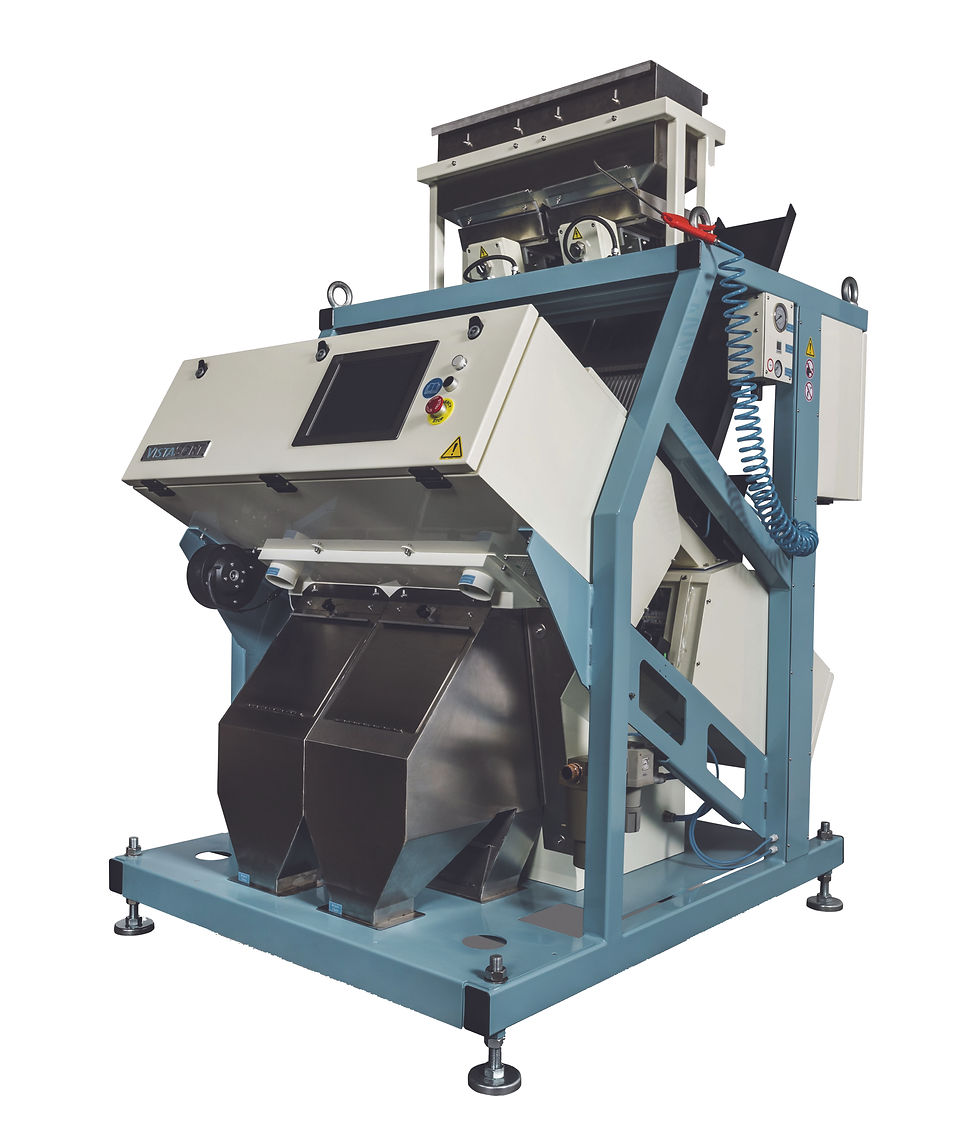
VistaSort 5-Chute
High-capacity optical color sorter built for large seed and grain processing facilities.


Built to Integrate Into Any Processing Line
VistaSort color sorters are designed to fit seamlessly into existing seed and grain processing lines or complete new plant builds.
Whether installed after a gravity separator, indent separator, or air screen cleaner, optical sorting provides the final step in achieving export-grade purity.
VistaSort systems are commonly integrated into:
-
Seed cleaning plants
-
Grain processing facilities
-
Pulse processing lines
-
Specialty crop operations
Many Western Canadian facilities use a process flow such as:

Air Screen Cleaner
Removes light material, chaff, and oversized or undersized product using precision screens and controlled airflow.
Clipper air screen cleaners are widely used in seed cleaning plants and grain processing facilities as the first step in the cleaning process.

Gravity Sperator
Separates product based on density to remove immature, damaged, or lightweight seeds.
LMC gravity separators are trusted across the seed and grain industry to improve product quality and maximize value.

Indent Separator
Sorts seed by length using rotating indented cylinders.
Carter Day indents are ideal for removing long or short contaminants, providing precise separation for cereal grains, pulses, and specialty crops.

Uses advanced optical cameras and intelligent image processing to remove off-color seeds, foreign material, and defects.
VistaSort color sorters provide the final step in achieving export-grade purity and consistent product quality.

Request a Quote
Looking to improve product purity, reduce shrink, or upgrade your processing line?
VistaSort color sorters are built to match your specific crop, capacity, and facility requirements.
Our team will help you choose the right machine configuration and provide a solution tailored to your operation.
